Mobile World Conference, Day 3: MWC's Attention Turns To Chips And Innovation Awards

Just walking around the show at any given time, about half the people I see are talking on a cell phone, texting, or looking at e-mail. That figures, since we’re at a show focused on the mobile industry. But overall, it’s an amazing phenomenon. Whatever happened to talking person to person directly?

Article Tools

Direct human contact seems to be going out of style. Communication has become more impersonal. Or, maybe I’m just too traditional or old-fashioned. My younger daughter said that at a party she attended recently, everyone was sitting around talking, but two-thirds of those people talking were on their cell phones.

Anyway, of all those cell phones, the BlackBerrys outnumber everything else except for Nokia phones. This is Europe so I would expect to see lots of Nokias, but BlackBerrys are very popular everywhere. I have only seen a few iPhones, but they are expensive here in Europe if you can get them at all.

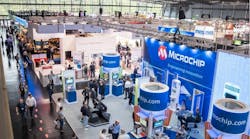
As for the show itself, it is certainly the mobile event. CTIA comes close, but you really get a better worldwide view at MWC—Europe for sure, but also Asia. With almost 2000 vendors, it is hard to see it all, if not impossible. The best strategy for this show is to try to focus on your own needs and zero in. Advanced planning via the GSMA Web site and early show info is essential.

Hot Chips

I spent most of the morning with Qualcomm, which is the IC leader in the cellular space (Fig. 1). Texas Instruments is a close second. The big news out of Qualcomm is its recent deal with Nokia to supply chips for some future phones. That really opens the door for Qualcomm to gain even more market share.

As for new products, Qualcomm’s MSM7227 handset baseband modem chip targets cell phones that cost less than $150. The chip runs HSDPA/HSUPA at full speeds and handles rich multimedia. It has two processors—one for the applications and another for the modem.

Most of these Qualcomm devices have two regular processors, typically ARM9 or ARM11, and two each of Qualcomm’s own proprietary DSPs. The MSM7227 features an ARM11 running at 600 MHz and a 320-MHz DSP with floating point. It is designed to support Android, Symbian S60, Windows Mobile, and BREW.

Qualcomm’s MSM8960 chip is a real killer device that can run cdma2000 1xEV-DO Rev. B as well as multicarrier HSPA+ and Long-Term Evolution (LTE). Incidentally, multicarrier HSPA+ uses two 5-MHz channels to boost speeds to 42 Mbits/s downlink and 11 Mbits/s downlink. It’s no wonder carriers will want to delay the investment in new LTE hardware when you can get this kind of performance from existing equipment and minor upgrades.

I had another meeting with the Qualcomm MEMS Technologies organization. Its mirasol display is based on interferometric modulation (IMOD) technology, which provides a way to change the dimensions of light cavities that in turn change the color of light reflected. The size of the cavity determines the color reflected. Each cavity is made up of two electrode plates. One is fixed, and the other can be varied by using microelectromechanical-systems (MEMS) principles.

With no voltage applied to the MEMS element, a designated color is reflected. With a voltage applied, one of the electrode plates moves and no light is reflected, so you see black. The result is a very simple monochrome display. Then by combining three cavities, one each that reflects red, green, and blue, you create a pixel that can produce any color by applying the right voltage levels.

The displays use reflected light only so they work best in direct sunlight, where most LCDs wash out. The good news is that no power-hogging backlighting is needed. These energy-efficient displays will get more popular as more functions and circuits are added to the already burdened smart phones.

Battery capacity, talk time, and idle time are critical. As subscribers demand more Internet access and video capability, their time between charges will significantly decrease. Qualcomm is just ramping up its mirasol display efforts, and I suspect you will be seeing more of them in the future.

Speaking of power consumption, smart phones are now taking advantage of very sophisticated power management. Dialog Semiconductor’s DA9052 programmable power-management chip provides everything you need for power in a high-end cell phone. It comprises four buck dc-dc converters with a 0.5- to 3.6-V range, 10 programmable low-dropout regulators (LDOs), a low-power backup charger, a high-voltage white LED driver, and a general-purpose analog-to-digital converter (ADC) with touchscreen interface.

The DA9052 additionally features a 16-bit general-purpose I/O (GPIO) bus, dual serial control interfaces, and one-time programmable (OTP) memory. With the software supplied, you can program the turn-on/turn-off times of all supplies. As portable and mobile devices get more sophisticated, a power-management chip like this will be a great help in designing a feature-rich product that won’t kill its battery.

I met with representatives of Atheros, Broadcom, and picoChip as well. Atheros and Broadcom are heavy hitters in the Wi-Fi chip space, and more and more cell phones are incorporating Wi-Fi for Web surfing and other applications. Both companies also produce Bluetooth and now GPS receivers. They have different versions of combo chips that put Wi-Fi, GPS, and Bluetooth and sometimes an FM radio together on a single chip for cell-phone usage. Broadcom additionally introduced some new baseband chips for HSPA. Meanwhile, picoChip showed off some of the applications for its 300 processor chip. The company is a leader in the femtocell implementation arena, and we can look for LTE femtos using a variation of this chip in the future.

And The Winner Is…

Finally, the GSMA announced its Innovation and other awards today, with too many winners to mention (Fig. 2). There were some highlights, though. The winners of the Mobile Innovation Global Award competition and EMEA tournament included:

  • Global Finalists: Advanced Receiver Technologies of the U.S. and Intivation of the Netherlands

  • Most Innovative Wireless Device-centric Technology: Intivation

  • Most Innovative Carrier Infrastructure: Sunbay

  • Most Innovative Application in a Vertical Market: WorldMate

  • Most Innovative Consumer Application: Mobile Nordic

  • Most Innovative True Mobile Start-Up: Advanced Receiver Technologies

Other awards of interest included:

  • Best Mobile TV Service: MobiTV

  • Best Mobile Handset: INQ1 (I haven’t seen one yet and cannot find one at the show here)

  • Best Network Technology Advance: Nokia Siemens Networks

  • Best Mobile Technology Breakthrough: RIM BlackBerry Storm 9500 SurePress Screen

  • GSMA Chairman’s Award: Research In Motion (RIM)

Finally, look for my summary coverage article, where I’ll identify the most important trends and happenings at the conference.

Related Articles

  1. 2009 Mobile World Congress, Day 1: Mobile Innovation Global Competition Heats Up
  2. Mobile World Congress 2009, Day 2: Mobile TV And Test Take MWC By Storm
  3. Qualcomm Snapdragon Chips Run Google Android

Want to use this article? Click here for options!
© 2010 Penton Media Inc.


Acceptable Use Policy blog comments powered by Disqus


Latest Issue

Features:

View Entire Issue

Most Popular Stories

Resources

Special Coverage

CTIA Wireless IT & Entertainment 2010

Read the latest from the show...