Telematics: Advancing the information society
[For a copy of this article in PDF format, which displays figures and equations, click here. Requires Adobe Acrobat Reader, free download.]
Is the interactive device of tomorrow a computer, a communicator or both? Telematics redefines the future of information exchange.
Telematics: A relatively new term that is formed from the words "telecommunications" and "informatik" (the German term for computer science). The term telematics implies that the once clearly defined demarcation lines of the two industries are graying.
While much of the publicity within the telematics camp comes from ever-increasing deployment of wireless (and wireline) communications in transportation systems, telematics is not limited to transportation.
Wireless telematics is not a new arena. But recent years' developments in both wireless and computing have made it much more achievable and less lofty. Generally, telematics is combining all of the possibilities inherent in wireless voice and data communications with the Internet, global positioning systems (GPS) location capabilities and ubiquitous data access to deliver location-specific secure information and productivity-enhancing services to people on the move.
Telematics is at home in any number of industries. Smart cards, home RF, the global information infrastructure (OK, the WWW as we fondly TLA (three letter acronym) it), medicine, mobile multimedia and any number of less-glamorous industries, such as RFID, will all be players in the telematics industry.
"Smart" everything As we get closer to realizing our ability to store massive amounts of data on minimal real estate, the once science-fiction images of robots, smart vehicles, self-regulating medical devices, smart appliances, real-time decision making data, holographs, and 24/7 "on-line" connectivity will be inextricably woven into our lives.
There is currently a frenzy of development in the smart card industry. Smart cards are one of the most intriguing aspects of the communications/computer fusion. They are poised to be the sole interface to the world around you - and without wires.
Credit card intelligence Smart cards of the future will contain a massive amount of molecular-, dark matter-, atomic-, DNA-based, or other yet-to-be-discovered high-density memory, and hold a universe full of data. Mobile commerce (m-commerce) will become the norm. Transactions will be an "always on-line" function. Whether it's something as simple as charging your personal credit account as your smart card is read wirelessly at your favorite drive-through restaurant, or as complex as monitoring your body's functions as you're being rushed to a hospital in an emergency.
One company at the forefront, Schlumberger, has developed a smart card for m-commerce. Called the wireless identity module (WIM), it is compliant with the wireless application protocol (WAP) and secures Internet transactions on mobile devices (for GSM platforms currently).
In the same vein, Visa has taken a step forward by implementing technology for wireless e-merchants using standard cards. Users fill out a form, use a PIN code and then buy and sell securely. In the future, As progress marches on, Visa, as well as other card suppliers, will implement support for additional authentication mechanisms, smart cards and secure electronic transactions. Expect smart cards to become the standard interface for the e- and m-commerce of tomorrow.
Telematics in medicine There is also a movement toward telematics in hospitals and medical services.
Devices will be implanted in the human body that will transmit information about a particular function, organ or area of interest. Mobile devices will be developed that can "map" body behavior, and even be used to fix things.
It is quite conceivable that, rather than swallowing a radioactive substance such as Berrium and following it with scanning equipment, a patient will swallow a tiny encapsulated wireless transmitter that will contain sensors to provide information about its travels throughout the body in real time. In the future, these tiny devices will be injected into circulatory systems to monitor and assess blood chemistry, flow and other related parameters (Fantastic Voyage, anyone?).
Telemetry devices are already integrated within artificial hip replacement procedures. These devices combine modern semiconductor electronics with RF transmitters that monitor joint stress via a computer interface. The data are analyzed and a real-time assessment can be made as to the effect of the forces being applied to the joint. Once gathered, such information is used to develop a lifestyle that minimizes joint stress and lessens or eliminates the possibility of future joint failure.
Telematics is also finding a home in health care for remote and underdeveloped regions. Today's multimedia-rich computing environment is ideal for telemedicine. The infrastructure is poised to deliver wireless telemedicine once wireless bandwidth becomes available. Doctors in remote regions can access a virtual plethora of resources, including contemporaries, libraries and even video teleconferences, using a computer with a wireless interface. Such capability is monumental in bringing badly needed 21 superscript st century medical technology to remote regions.
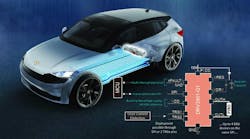
The more visible telematics As the cover article supports and much publicity points out, telematics' most visible progress is in the transportation industry. In fact, it appears at this early stage that the defacto definition of the word "telematics" may generically refer to this industry.
With good reason. The transportation industry is poised, ready, and willing to integrate computers and wireless into its products and systems. Vehicle telematics, called in-vehicle information systems (IVHS) by some, is predicted to be an $8 billion global industry by 2005.
But "telematic" technology isn't all that new. A system that has been on line for years now, ARDIS, presently owned by Motorola and previously in joint venture with IBM, is a classic example of early telematics. While fairly simple early on, the latest evolution offers two-way, real-time wireless messaging to other ARDIS personal messaging subscribers, wireless faxes and Radio Mail (a two-way, interactive, wireless messaging service that allows mobile users to ride the Internet wave and communicate with other subscribers) and also provides information bulletin services such as the latest news and sport scores.
Other functions, such as complex vehicle location services (GPS and terrestrial-based), traveler information, traffic monitoring, emergency vehicle summons and routing, and interactive in-vehicle services, are starting to show up nationwide. As the technology and infrastructure continue to evolve, vehicle telematics will follow the evolution on a worldwide basis.
On a consumer level, vehicle manufacturers are starting to integrate GPS-based location and information systems with vehicle design and manufacture. Perhaps the most visible and progressive implementation of present-day, state-of-the-art telematics is General Motors' Onstar. Onstar integrates with a cellular interface and, using the cellular infrastructure and the Internet, can offer services such as destination guiding. It can also sense occurrences such as airbag deployment and can perform remote diagnostics if a warning light comes on. It can even remotely unlock the driver's door. Future services will include e-mail, news, stock functions, weather, sports and hotel and restaurant reservation capability.
Where we're headed Telematics, all flavors, will become a generic platform for computer/communications-based wireless technology. As discussed earlier, computer-based communications appliances wired to the Internet, combining both voice recognition and broadband video (and containing massive amounts of artificial intelligence), will be the enablers of this century.
Want to use this article? Click here for options!
© 2009 Penton Media Inc.
Acceptable Use Policy blog comments powered by Disqus
advertisement
Most Popular Stories
advertisement
advertisement