New Solutions Put Wireless To The Test

Recent advances have made it possible for test vendors to provide off-the-shelf chipset-specific solutions for Wi-Fi, Bluetooth, and WiMAX RF test.

With wireless technology finding its way into all sorts of devices and commercial applications, test engineers are increasingly demanding complete RF test solutions oriented around particular chipset vendors. Test equipment vendors have been quick to react to this demand by collaborating with manufacturing test engineers and silicon vendors to make it easier and quicker for test engineers to design and test wireless devices and products.

Article Tools

This three-way communication between manufacturer, silicon vendor, and test equipment vendor encompasses the necessary information sharing and technical problem solving required to produce test solutions. In fact, test engineers often choose RF test equipment hardware based on what the test equipment vendor can offer as a complete solution. For example, typical solutions for testing a particular wireless local-area network (WLAN) device consist of three main elements:

  • Chipset control: The necessary chipset software from the silicon vendor to control and operate the device under test (DUT) to allow it to transmit and receive in the required modes for calibration and verification testing
  • Test equipment: The test vendor equipment that tests the DUT
  • Test software: Software that comprises components from both the chipset control software and test equipment automation, allowing the test engineer to execute a test plan that often takes the form of a test executive

While test equipment vendors continue to provide these three main elements, chipset solutions are evolving. Chipset-specific solutions are becoming off-the-shelf software packages. RF test hardware perhaps has been seen as the most important part of the overall solution, and indeed it is still critical to testing success. However, chipset-specific software is playing a much greater role.

Test engineer decisions are becoming less focused on the details of what RF hardware and software components do. Rather, they are increasingly being influenced by the availability of an off-the-shelf chipset solution that is specific to the chipset to be tested and if the silicon vendor has qualified the solution. Such software now includes recommended test plans consisting of optimized and modular test steps defined and documented in an application programmable interface (API).

The availability of off-the-shelf chipset solutions now enables RF test engineers to focus on the development of their software to integrate the API. Off-the-shelf solutions eliminate the need to consider alternative approaches to “systemize” everything because the software already works with test equipment and the DUT. This interface is designed to be easily integrated into the engineer’s test environment or test executive using a task-orientated approach to the specific chipset, as opposed to a multitude of API calls that are specific to the DUT or test equipment.

Benefits Of These Solutions

Chipset-specific requirements and the growing demand for associated test solutions aren’t just attributed to growth in new technologies such as WLAN, Bluetooth, and WiMAX. Test vendors are providing chipset-specific software solutions that offer complete, packaged solutions that are verified and optimized by the silicon vendor.

These flexible-use models (partially automated and fully automated) can support a variety of device implementations. Furthermore, these solutions provide a task-oriented programmable API and full test plans suitable for use throughout the test lifecycle. And, they reduce the end customer’s need for silicon vendor support.

Complete Packaged Solutions

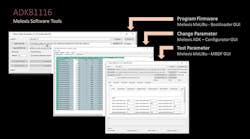
Chipset control must be packaged in an easily accessible, ready to use form. An installable and documented solution allows engineers to begin testing quickly without having to compile and learn how to combine all the test elements. An off-the-shelf software tool is the only one that the engineer needs to run and/or integrate into a test executive, focusing the task of silicon vendor-specific test development on software alone (Fig. 1).

The software’s operation should also be explained in appropriate documentation. For engineers wishing to automate and use the API in a specific programming environment, short example programs provided in the documentation can be helpful.

A Verified And Optimized Vendor Solution

An off-the-shelf, chipset-specific software test solution is produced in collaboration with silicon vendors and test equipment vendors, who jointly validate and qualify RF test with the silicon vendor’s calibration and test verification requirements (and those of the end users of the software).

Want to use this article? Click here for options!
© 2012 Penton Media Inc.


Acceptable Use Policy blog comments powered by Disqus


Latest Issue

Features:

View Entire Issue

Most Popular Stories

Resources

Special Coverage

CTIA Wireless IT & Entertainment 2010

Read the latest from the show...